

The Economic benefit of biobased building with trees address CO2 paradox is revolutionary
“The scale of the Biobasecamp pavilion at DDW clearly demonstrates CLT‘s (cross laminated timber) structural and environmental benefits, and its amazing potential for large scale commercial architecture and infrastructure projects.”
—Bernard McCoy
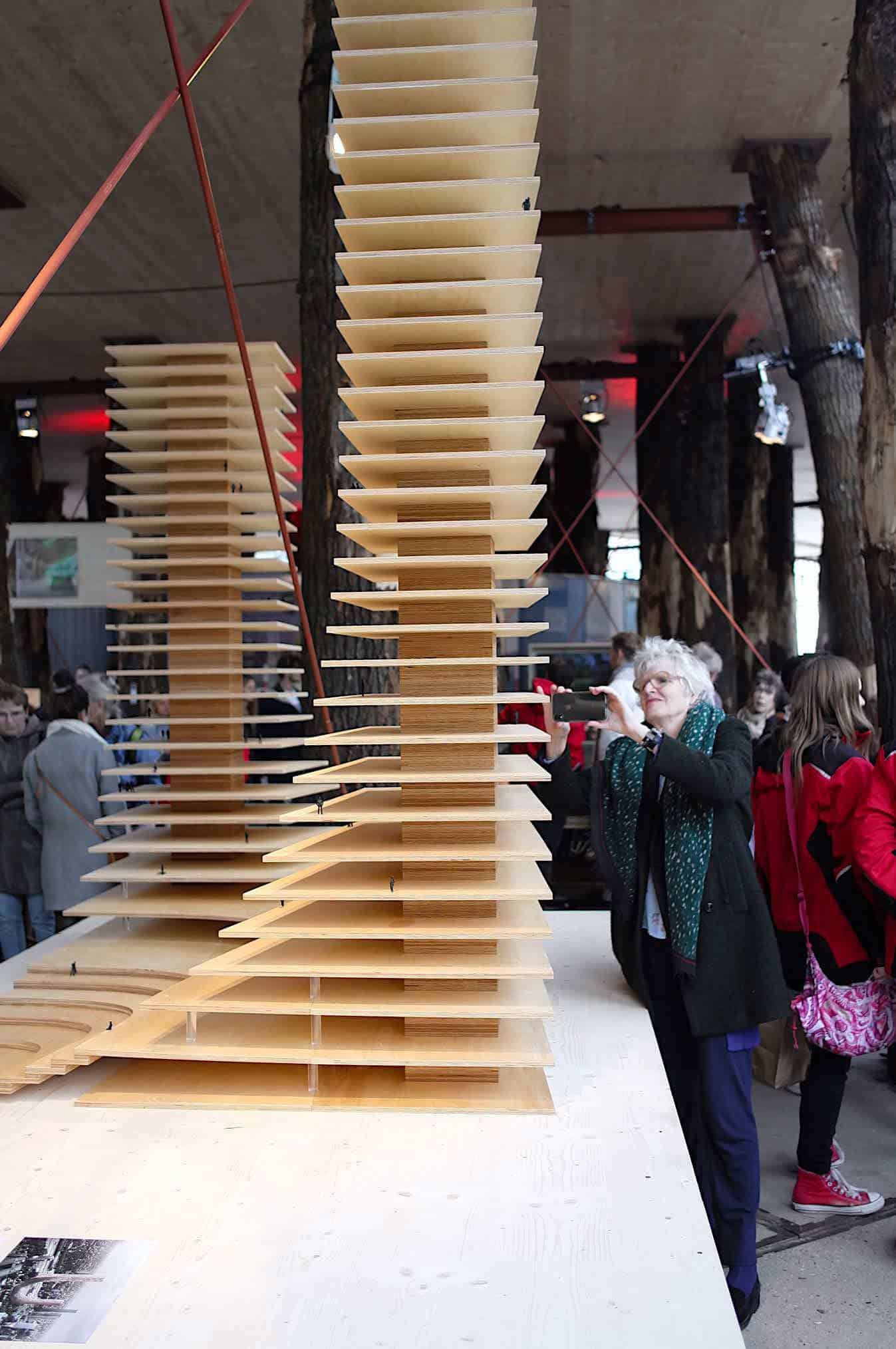
The construction industry is the single most polluting industry in the world. Biobasecamp is a pavilion and architectural expression of how “building with trees” can contribute to the reduction of CO2 and the reduction of nitrogen by replacing conventional building materials such as concrete with biobased materials.
Biobasedcamp‘s deck is composed of large modular floorboards made of cross laminated timber. After Dutch Design Week, these can then be reused. By creating more economic value for local woods, more forests can also be planted. The Dutch building assignment can in this way contribute to combating climate change and the quality of the Dutch landscape. This may also apply to the Brabant poplar landscape that originated from the production of clogs and matches. That is why the deck is supported by branches of poplars from the vicinity of Eindhoven.
The Biobasecamp generates a starting point of exploration for designers and clients towards the possibilities that this “concrete of the future” offers. May this pavilion similarly mark the possible turning point for a new era.
Founding partners: Studio Marco Vermeulen, Derix, Provincie Noord-Brabant, Floriade, Arup, Dutch Design Foundation.
 Timber construction
Not only the Netherlands but the whole of Europe faces a paradoxical task: building more houses and emitting less CO2. Does building with timber provide the solution? When building with cement, concrete and steel, around 55 million tonnes of CO2 are released in the construction of one million new buildings. Cross laminated timber (CLT) does not cause any emissions but stores CO2. In addition, it can be used to build “prefab house”, so much faster. What are the possibilities and obstacles to the large-scale application of CLT in construction? Are we on the eve of a “wood age” or is that too good to be true? Is there enough space for the required production forests? And should “nature” be traded commercially in this way?
The film “Timber constructions” on the public broadcaster VPRO in the Netherlands sheds light on this topic and shows illustrative examples – e.g. the Hotel Jakarta in Amsterdam and the Biobasecamp at the Dutch Design Week in Eindhoven – both projects realized with X-LAM elements of the DERIX Group. A time-lapse of the construction of the pavilion can be seen at